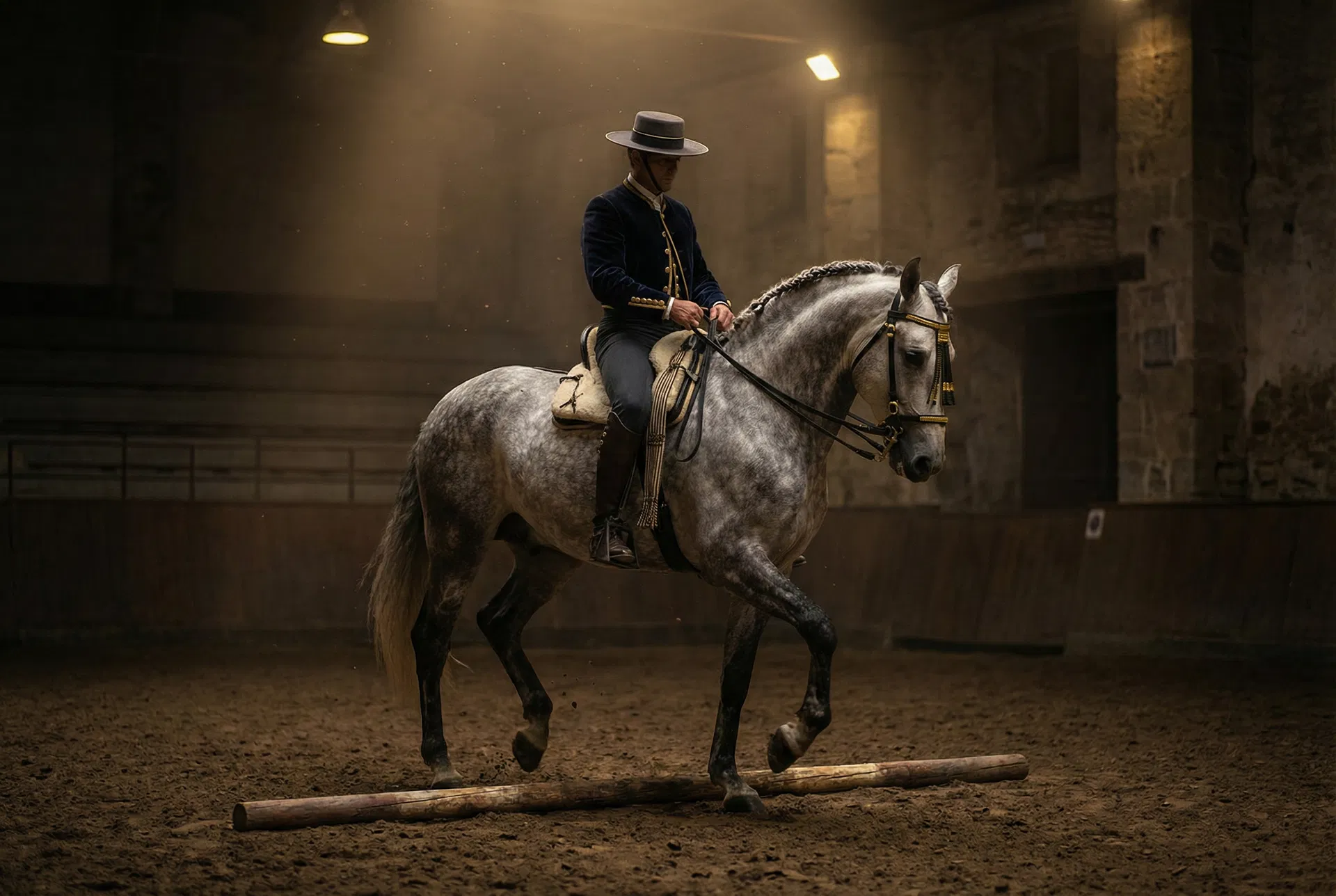
Working Equitation is exploding in popularity across the United States. But what exactly is it? This comprehensive guide explains the origins, the four competition phases, and why riders from every background are falling in love with this discipline.
If you have spent any time around barns or equestrian social media recently, you have likely heard the term "Working Equitation" (WE). It is frequently described as the fastest-growing equestrian sport in the United States, attracting riders from both English and Western backgrounds.
But what exactly is Working Equitation? Why are dressage riders trading their double bridles for garrocha poles, and why are western pleasure riders suddenly obsessed with half-passes?
This comprehensive guide will explain the origins, the rules, the four distinct phases of competition, and why this discipline is transforming how we train and ride horses.
The Origins of Working Equitation
Working Equitation is a discipline designed to test and celebrate the skills required of a working horse on a farm or ranch.
While the sport is relatively new to the United States, its roots are deep in the Iberian Peninsula — specifically Portugal and Spain — as well as France and Italy. In these countries, horses were historically used to herd cattle, navigate rough terrain, and perform intricate maneuvers in tight spaces.
The modern sport of Working Equitation was created to preserve these traditional riding techniques and the specific tack and attire associated with them. Today, it is a highly structured, internationally recognized competition that demands a horse be obedient, agile, brave, and incredibly well-balanced.
The Four Phases of Working Equitation
A complete Working Equitation competition consists of four distinct phases. At the lower levels, competitors may only ride the first two or three phases, but at the highest levels, all four are required.
Phase 1: Dressage
The foundation of Working Equitation is classical dressage. In this phase, horse and rider perform a prescribed pattern of movements in a standard dressage arena. However, unlike competitive modern dressage, the focus in WE dressage is on practical application. Judges look for a horse that is forward, relaxed, and attentive, demonstrating the balance and suppleness needed to navigate obstacles later.
Phase 2: Ease of Handling (The Obstacle Course)
This is the phase most people associate with Working Equitation. The Ease of Handling trial requires the horse and rider to navigate a course of 10 to 15 obstacles designed to simulate challenges found in the field. Common obstacles include the bridge (walking calmly over a wooden platform), the gate (opening, passing through, and closing without letting go), the figure eight around barrels, the garrocha pole, and the sidepass over a ground pole.
In the Ease of Handling phase, precision, calmness, and harmony are paramount. The judge evaluates how smoothly and confidently the pair negotiates each challenge.
Phase 3: Speed
The Speed phase uses the same obstacle course as the Ease of Handling phase, but the objective changes entirely. Instead of being judged on style and precision, the pair is judged solely on time. The fastest time wins, but there are time penalties for knocking over obstacle components or failing to complete an obstacle correctly. This phase tests the horse's bravery, agility, and the rider's ability to maintain control and balance at high speeds.
Phase 4: Cattle Handling (Cow Trial)
The final phase is a team event, usually involving three or four riders. The team must work together to separate a specific, designated cow from a herd and move it into a holding pen within a set time limit. This phase tests the horse's "cow sense" and the rider's tactical skills. It is the truest test of a working horse's original purpose.
Why is Working Equitation So Popular?
The explosive growth of Working Equitation in the USA can be attributed to several factors.
Inclusivity of Breeds and Tack. Unlike some disciplines that favor specific breeds, WE is open to all. You will see Lusitanos and Andalusians competing alongside Quarter Horses, Thoroughbreds, Arabians, and draft crosses. Riders can compete in English, Western, or traditional Iberian tack and attire.
A Purpose for Dressage. Many riders love the principles of dressage but find riding 20-meter circles in an empty arena tedious. Working Equitation gives dressage a tangible purpose. You need a half-pass to open the gate; you need a collected canter to navigate the slalom.
The Ultimate Test of Partnership. Navigating a bridge, sidepassing over a pole, and galloping through a speed course require an immense amount of trust. WE exposes holes in training quickly, but it also provides a clear, fun roadmap for fixing them.
A Welcoming Community. The WE community in the USA is known for being incredibly supportive and encouraging, focusing on horsemanship and camaraderie over cutthroat competition.
How to Get Started in Working Equitation
If you are intrigued by Working Equitation, the best way to start is by incorporating its principles into your daily rides. Master the basics first — your horse must be responsive to your seat and leg aids, able to halt squarely, and back up willingly. Then introduce obstacles slowly, starting with simple ground poles and building a simple gate using two jump standards and a rope. Focus always on calmness: the goal in the beginning is relaxation and understanding, not speed.
At Hussar Stables, our entire curriculum is built upon the foundation of Working Equitation and Alta Escuela (High School) classical principles. We believe this is the most effective way to develop balanced, capable riders and calm, responsive horses — skills that transfer beautifully to any discipline.
If you are in the Palmdale, Lancaster, or Santa Clarita area and want to experience this training philosophy firsthand, book an Intro Lesson with us today.
Ready to Experience This in Person?
Book a private Intro Lesson at Hussar Stables and discover why families from Palmdale, Lancaster, and Santa Clarita choose our members-only riding club.
Book Intro Lesson